The story
Why am I building MLGuerrilla?
I’m building MLGuerrilla because I wanted something like this when I was trying to get into AI engineering. I wanted someone who had actually been paid to build AI systems to tell me what actually mattered to employers and what was worth building.
Who am I writing for?
I’m writing for software engineers who want to move into AI engineering. I’m also writing for computer science students and new grads who know they want AI roles.
You don’t need permission to start, and that was a big shift for me. I had a computer and access to LLMs, so I could start building even before anyone trusted me with the title.
It’s important to know where to put your energy, because a shallow project makes your resume look like everyone else’s. A project with evals, traces, risk decisions, and deployment tradeoffs gives you something concrete to talk about.
Why I can speak on this
I started taking AI seriously in 2022. I was still early in my career, which turned out to matter. I had room to make an early bet on AI. I wanted to get into AI engineering, so I focused there.
My first internship was at an AI lab in an R&D department, where I was the first undergrad they'd taken. This role was meant for master’s and PhD students since undergads usually don't have AI specific knowledge or skills, but I had proven myself through my personal projects, agency, and ambition. I had a lot of gaps though. Mainly in understanding what it meant to build production level AI systems. This first internship showed me what those gaps were and helped me close them. They liked me enough to extended my offer for a second intenrship term.
That internship became the platform for the next step. I became an Applied AI Engineer straight out of undergrad. Today I work in big tech on AI systems professionally, including computer-use agents and AI tools for developer productivity. I’m also pursuing a master’s in computer science and data science with a focus on AI and machine learning.
I’m saying this for one reason: I know what it feels like to try to break into this field without the clean, elite path people usually imagine. I also know the work that made people take me seriously, and that's what I want to give you here.
What bothered me
Like I mentioned in my intro, I got lucky because I was still in university when the AI industry started taking off, so I hadn’t started my career yet. I didn’t have to spend years trying to get my foot in the door as a software engineer and then convince someone to let me move into AI. A lot of people started their careers before me, so they never got that head start.
Some have been working as software engineers for years, and some tried to get into AI engineering but couldn’t find a way in. Now they see the field still growing fast and want to switch, but they don’t know where to start or which new skills they need. Those skills are what I cover on MLGuerrilla.
Now, for students and new grads, the problem starts even earlier. Computer science degrees were already bad at preparing people for software engineering jobs. I’m not saying getting a degree is bad, because, yes, you will learn a lot with your degree. It just won’t be the things you need for a job. They’re even worse at preparing people for AI engineering jobs.
That really annoyed me because I was there once. People pay thousands for a degree and go through a lot to finish it, then start looking for work and find they have almost none of the skills the job asks for. Employers expect you to know things university never taught you.
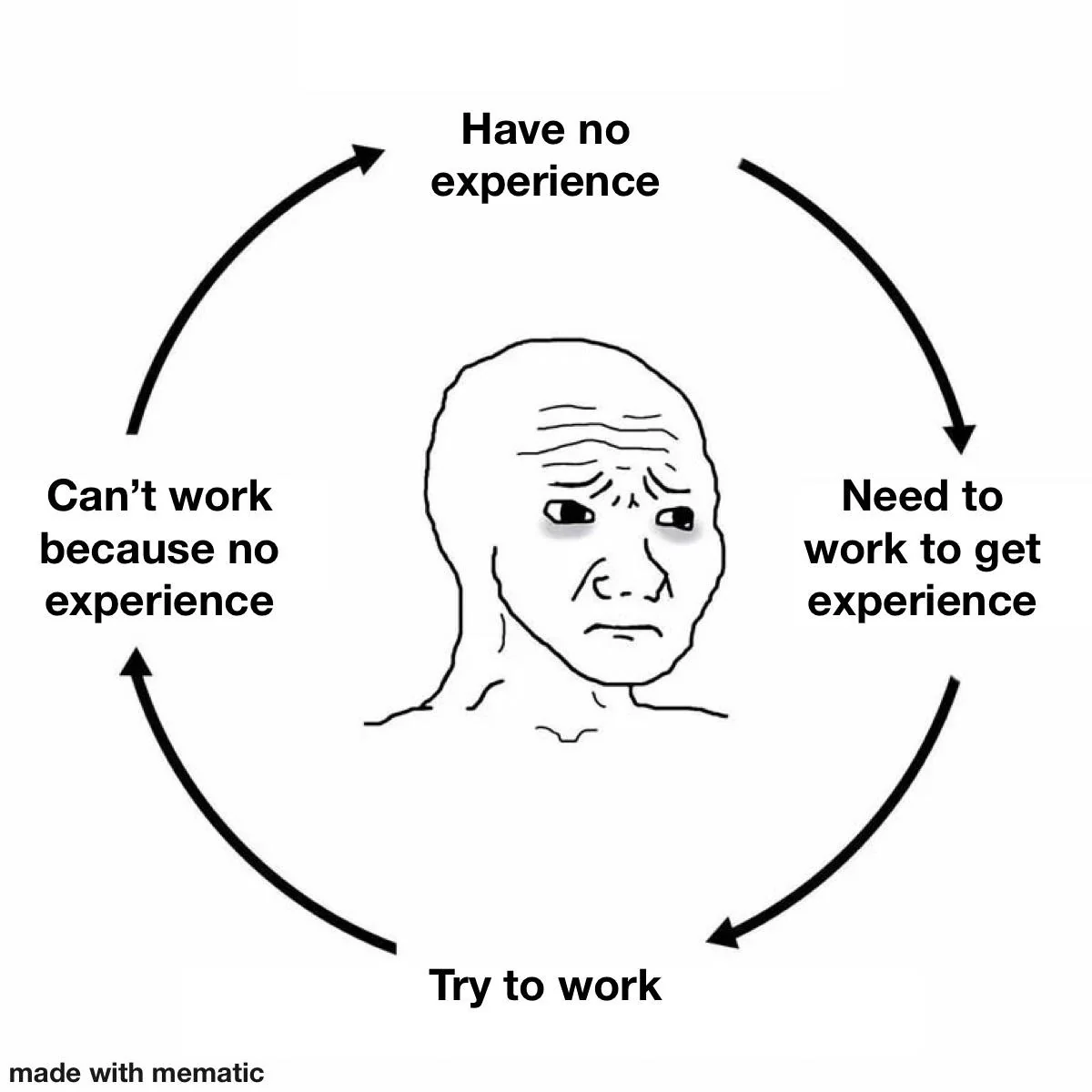
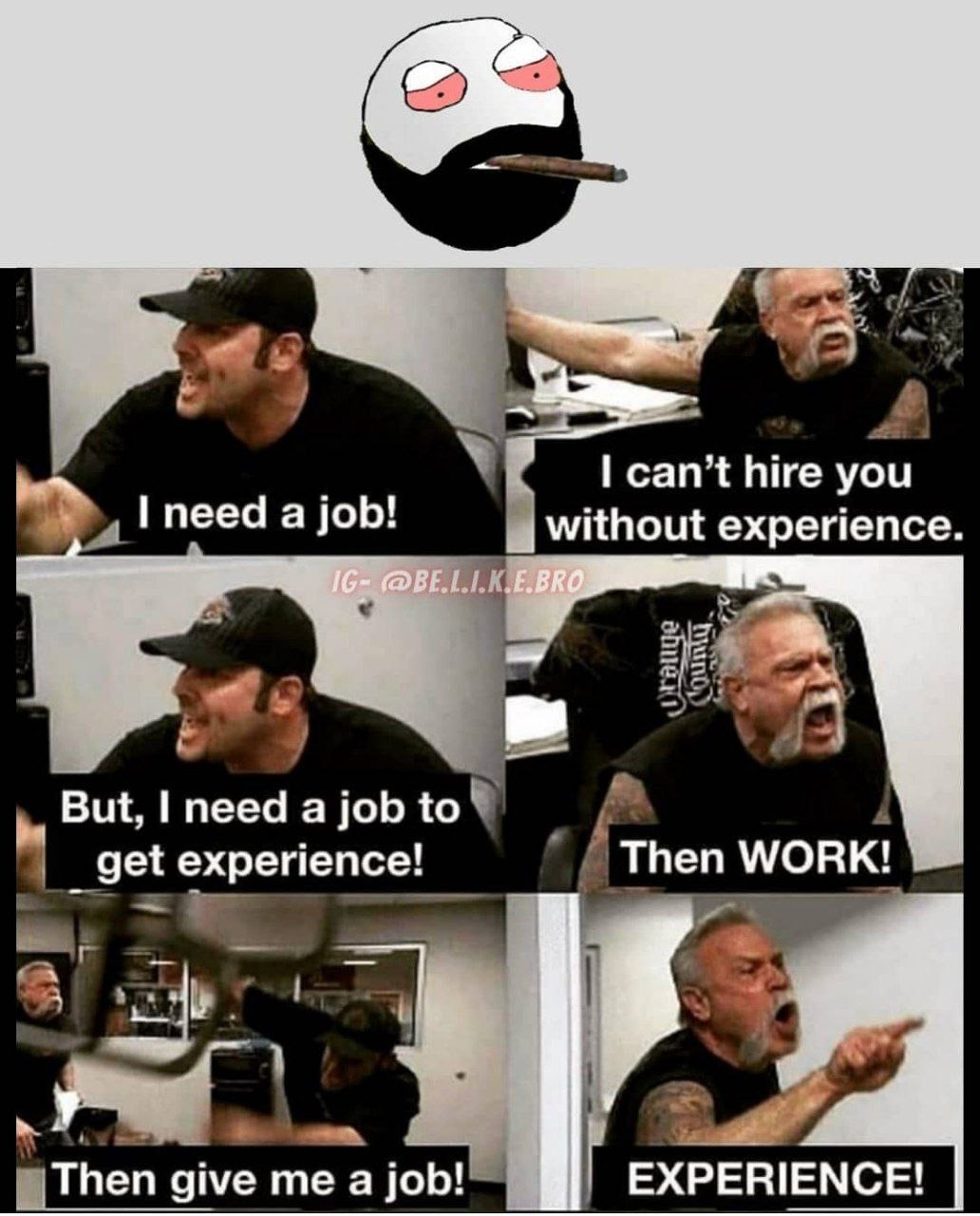
So you end up in a loop. You need experience to get experience.


The internet didn’t help much either. I found a lot of people acting like wiring an API to a UI was the whole field. Most youtubers are hobbyists, not professionals with the resources, training, and credentials, nor are they trying to build production AI for big tech companies, because that's simply not their job. You’ve probably heard people call AI apps “ChatGPT wrappers.” And most of them are exactly that.
If your app sends a prompt to an API and puts the answer in a nice UI, it’s not what gets you a job. I want to help you to understand the difference between an AI project and a production AI system.
For example, one of the simplest questions you can get asked is: “How do you know your prompt actually improved the reponses?” If your answer is “the responses felt better,” that’s not good enough for a real AI system. A real answer talks about evals, the dataset you tested on, the failure cases you tracked, the metric you cared about, and what changed after the prompt update.
That’s the kind of answer I want to help you build, because it’s the kind of answer an AI engineering hiring manager wants to hear.
What I wish I had
If I had even a small part of this material when I was starting, I would have moved faster because I would have known what to study and which parts were worth building.
That is why I’m sharing my knowledge on here. The value I wish I had is right there for you to grab, so if you say you want to become an AI engineer, read it and build from it. Then make something that proves you can do the work before anyone gives you the title.
Start with the modules.
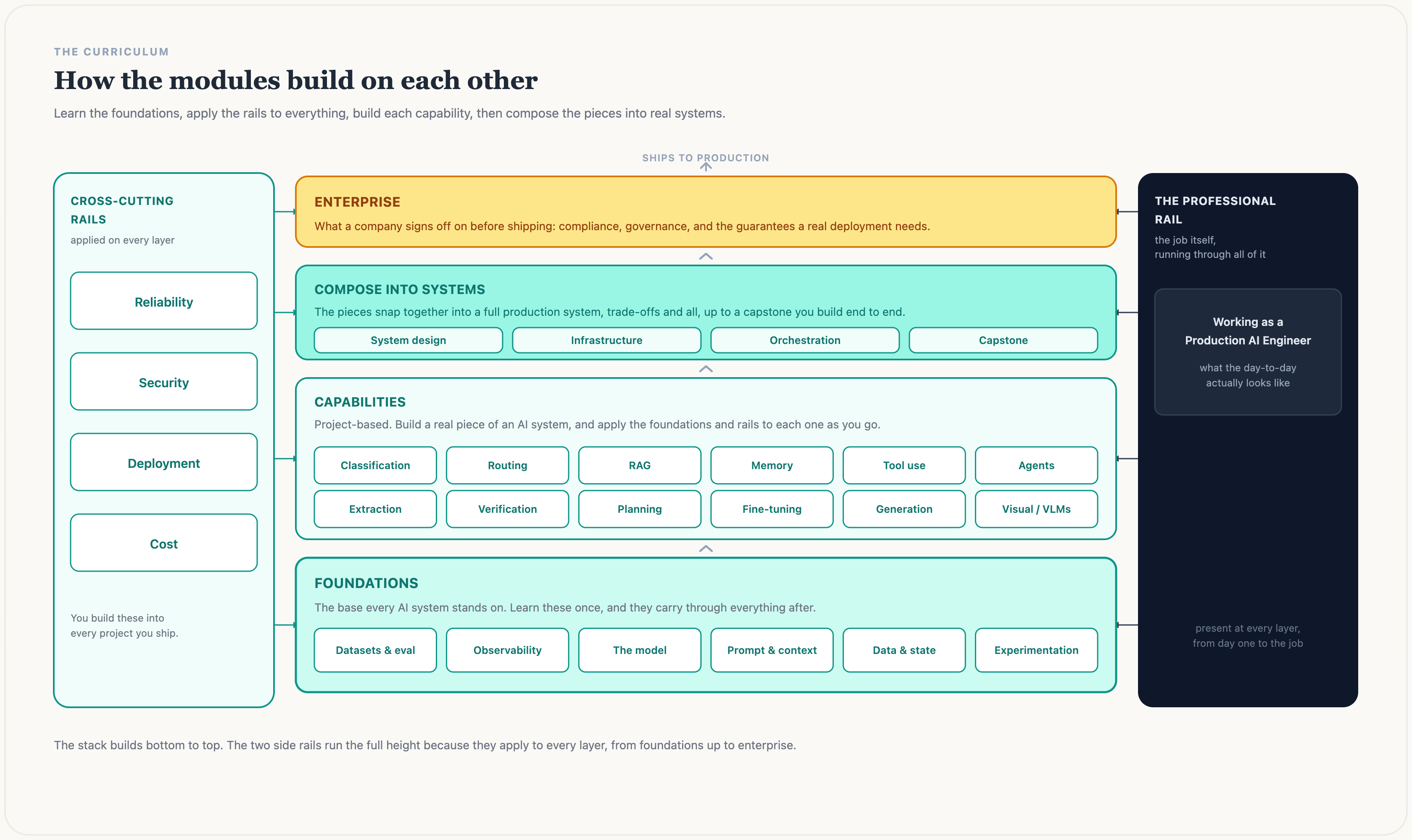
I’ve spent a lot of time making sure the modules teach something genuinely useful. They move in layers, each building on the one before, from the fundamentals up to the job itself.
- Foundations. The base every AI system stands on. Learn these once, and they carry through everything after.
- Cross-cutting rails. The concerns that show up on every project, whatever you build: reliability, security, deployment, and cost.
- Capabilities. Project-based. Each one has you build a real piece of an AI system and apply the foundations and rails to it as you go.
- Compose into systems. Where the pieces snap together into a full production system, trade-offs and all, up to a capstone you build end to end.
- Enterprise. What a company signs off on before anything ships: compliance, governance, and the guarantees a real deployment needs.
- The professional rail. What this work looks like as an actual job, so the day-to-day of a production AI engineer is not a mystery.
Read one, build the project, and keep going until your work looks like something an AI engineering team would recognize.